
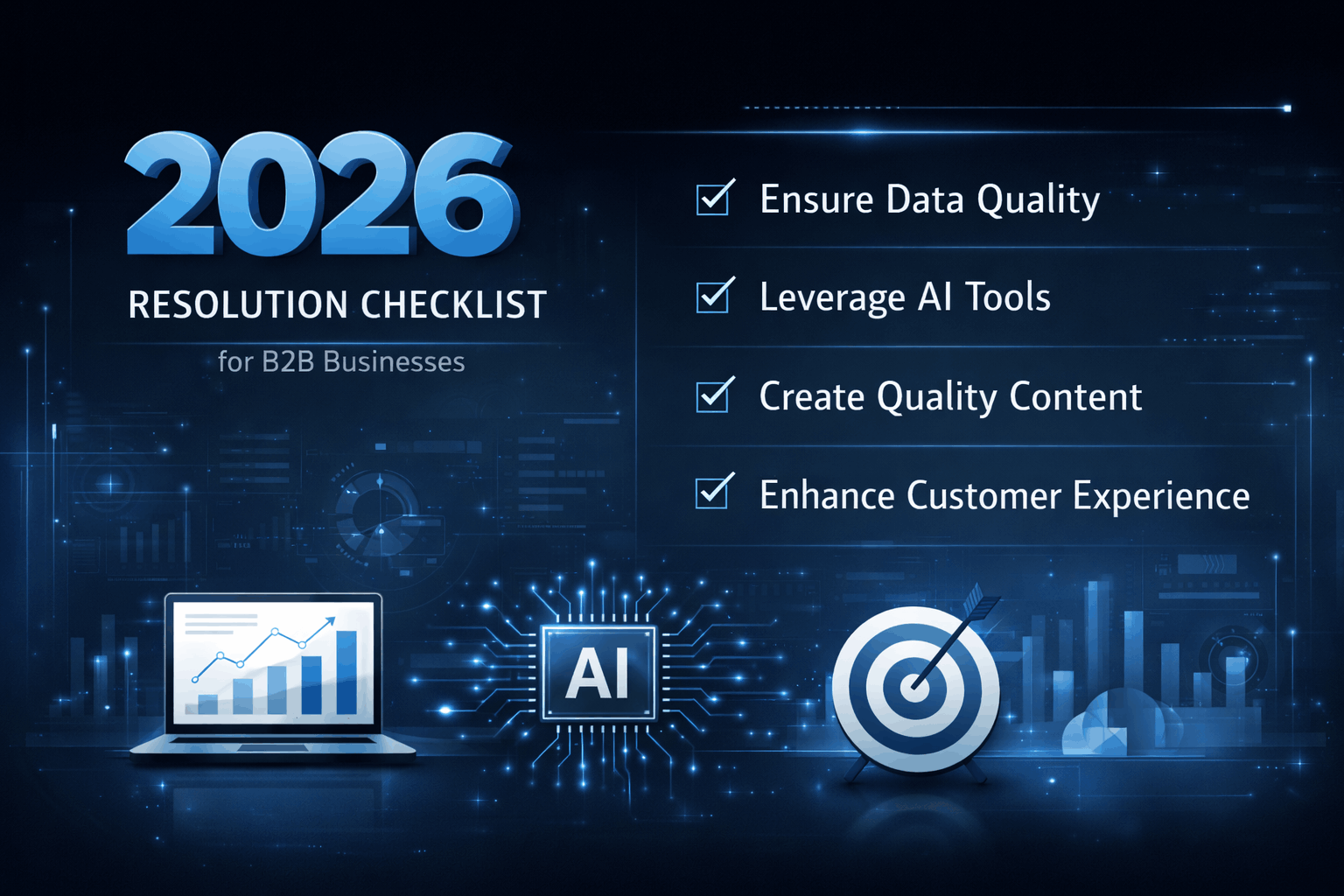
As we enter 2026, B2B marketing is undergoing a profound transformation. Buyers are more sophisticated, and the tools at our disposal are more powerful than ever. Yet success isn’t about chasing every trend. It’s about making strategic commitments that position your brand for sustainable growth.
Invest in Quality Data Over Quantity
The foundation of successful B2B marketing in 2026 is accurate data. With buyer behavior becoming increasingly complex and decision-making teams expanding, your ability to reach the right person with the right message depends entirely on the quality of your lead data.
The market is flooded with lead generation tools promising massive contact lists, but volume without verification is worthless. Inaccurate data wastes your team’s time, damages sender reputation, and burns marketing budget on prospects who don’t exist or aren’t decision-makers. With email deliverability becoming more stringent, poor data quality could get you blacklisted.
Industry leaders like Chain Store Guide have set the standard through primary research methodology that ensures up to date contact data. A more targeted list of verified current contacts will always outperform a massive database of outdated information. In B2B marketing, precision beats volume every time.
Embrace AI as Your Co-Pilot, Not Your Replacement
Recent industry data shows that 57% of B2B teams now use AI chatbots, with 26% reporting a 10 to 20% lift in lead generation. The winners aren’t replacing their strategy with AI. They’re the ones using AI to amplify their human expertise.
AI excels at pattern recognition, data analysis, and repetitive tasks like audience segmentation, personalized outreach, and identifying high-intent prospects. But it cannot replace the strategic thinking, emotional intelligence, and authentic relationship-building that defines exceptional B2B marketing. Reserve strategic decision-making, brand voice development, and relationship building for your human team.
Prioritize Quality Content Over Quantity
The internet is drowning in AI-generated content, and buyers can spot generic, keyword-stuffed articles from a mile away. In 2026, audiences respond to stories with substance: case studies backed by real data, original research, and first-hand expertise.
Content is now a risk reducer. Industry research confirms that 95% of B2B buyers want more depth and detail in content, particularly case studies and ROI calculators. Audit your content library and identify your top-performing pieces with actual conversion metrics, not vanity metrics.
Master Account-Based Marketing with Precision Targeting
Account-Based Marketing is table stakes. The companies winning in 2026 have moved beyond basic ABM tactics to create truly personalized, multi-threaded campaigns that engage entire buying committees.
The challenge? ABM requires exceptional data quality and deep account intelligence. You need to know not just who the decision-makers are, but also their current technology stack, recent expansions, budget cycles, and competitive landscape.
Optimize for the Modern Buyer Journey
B2B buyers now complete approximately 70% of their research before ever engaging with a sales representative. Research shows that buyers say if your website experience is poor, they’ll avoid doing business with you entirely.
Your website, content library, and digital touchpoints must answer questions, provide social proof, and build confidence before a human conversation begins. Map your actual buyer journey based on customer interviews, not assumptions.
Measure What Matters and Kill Vanity Metrics
Marketing accountability has never been higher. CFOs want to see ROI, not engagement rates. In 2026, the marketers who keep their budgets are those who can draw a clear line from marketing activities to revenue.
Get ruthless about what you measure. Track metrics that indicate buyer intent and sales readiness: MQLs to SQLs conversion rate, pipeline velocity, customer acquisition cost, and customer lifetime value.
Adapt Your Strategy for Generational Shifts in B2B Buying
The face of B2B decision-making is changing rapidly. Millennials and Gen Z now make up a significant portion of buying committees, and they research and evaluate vendors very differently than previous generations.
According to LinkedIn’s 2025 B2B Marketing Benchmark Report, 75% of B2B buy-side stakeholders will use social media to gather information about vendors and solutions by 2026. More than half of professionals now use social channels as search and discovery tools, mirroring consumer behavior.
Younger buyers expect video content, authentic peer reviews, and social proof. They’re less impressed by traditional sales pitches and more influenced by thought leadership, user-generated content, and recommendations from their networks.
The key is to create a multi-channel strategy. Use verified data to identify age demographics and seniority levels within your target accounts, then tailor your approach: LinkedIn articles and webinars for senior executives, short-form video and social selling for younger influencers, and case studies and ROI calculators for financial decision-makers.
Making Your Resolutions Stick
New Year’s resolutions fail when they’re vague aspirations rather than concrete action plans. The difference between a successful B2B marketer in 2026 and one who falls behind won’t be knowledge. It will be execution.
Start with one resolution. Build the habit. Then add another. For many marketers, the highest-ROI starting point is investing in quality data. Without accurate, verified contact information and market intelligence, every other tactic becomes guesswork.
Make this the year you commit to quality over quantity, precision over volume, and strategy over tactics.
Sources:
Gartner Research, “Future of Sales 2025”
LinkedIn B2B Marketing Benchmark Report, 2025




April 9, 2026
The teams pulling ahead aren’t using more tools. They’re using better data. There is no shortage of AI hype. However,https://www.chainstoreguide.com.

February 4, 2026
After 30 years of serving up Caribbean vibes and tropical cocktails, Bahama Breeze is calling it quits. Darden Restaurants announcedhttps://www.chainstoreguide.com.
January 23, 2026
B2B lead generation is changing fast. The old strategy of chasing volume over quality? It’s not working anymore. Companies arehttps://www.chainstoreguide.com.