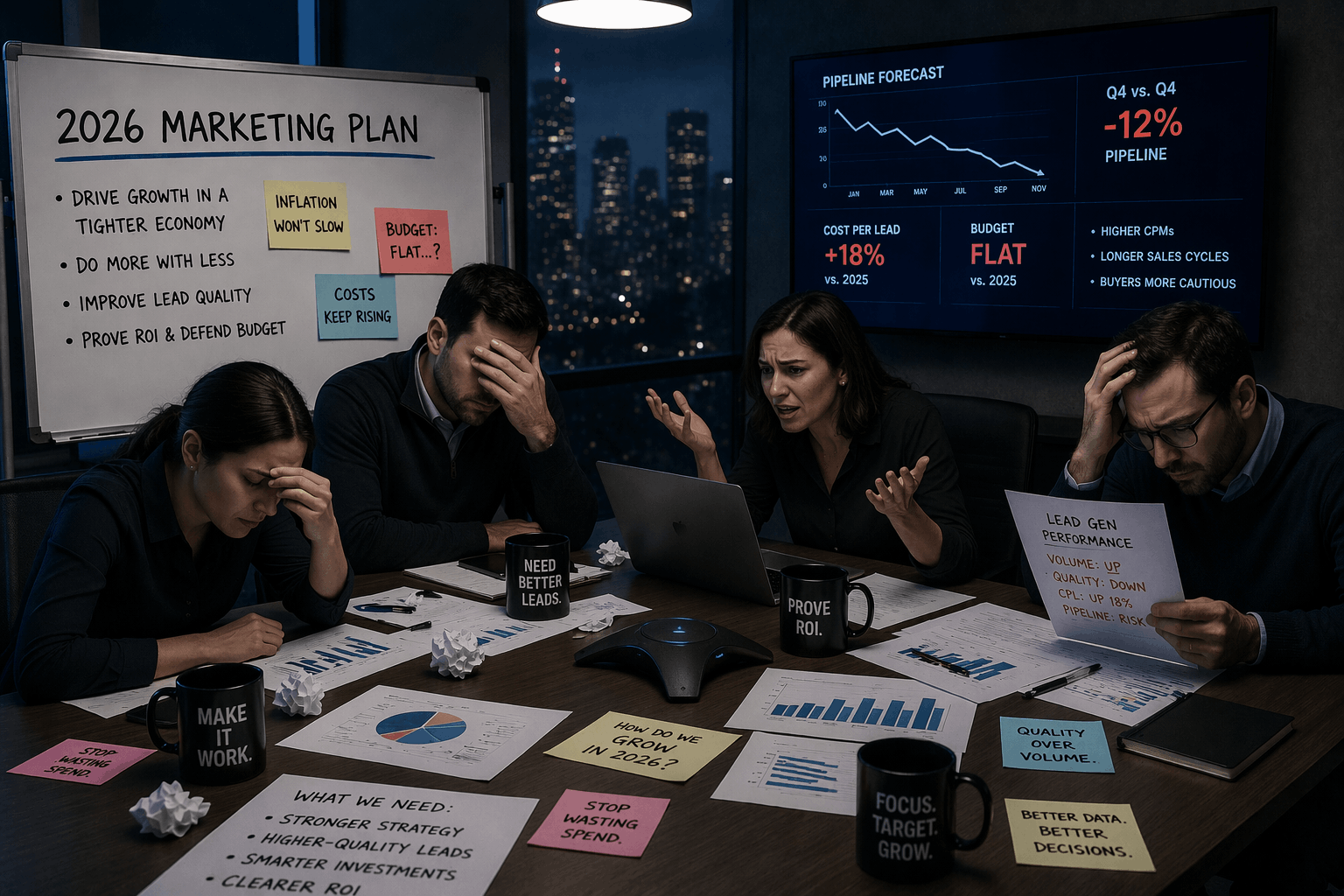
Welcome to the Outmarket Series. This is a content lineup by Chain Store Guide built for B2B companies that want to stop playing defense and start gaining ground. Each installment takes on a specific challenge and breaks down how the smartest companies are turning it into a competitive advantage.
Everything costs more right now. Your software subscriptions went up. Your ad spend doesn’t stretch like it used to. And somewhere in a conference room, someone is suggesting you cut the marketing budget to make the numbers work.
That instinct is the most expensive mistake you can make right now.
When your competitors slash their marketing budgets, and most of them will, the noise drops. Fewer ads compete for your buyer’s attention. Your message has a better chance of landing because everyone else went quiet. According to Forrester’s 2025 Budget Planning Survey, 47% of B2B marketing decision-makers expected budget increases of just 1% to 4%. Factor in inflation, and that’s effectively flat. In 2026, 37% of U.S. marketers were asked to make cuts, and even those with the biggest budgets reported the lowest confidence in meeting growth targets according to 10Fold research.
That’s your opening.
A landmark Harvard Business Review study found that 80% of companies that survive a downturn take more than three years to get back to pre-recession growth rates. But 9% came out stronger, outperforming rivals by at least 10% in sales and profits. The difference? They combined operational efficiency with greater investment in marketing while competitors pulled back. The IPA dataBANK confirmed the mechanism: for every 10 percentage points that a brand’s share of voice exceeds its share of market, it gains roughly one point of market share per year. During a downturn, when media costs fall and competitors go quiet, gaining that excess share of voice becomes dramatically cheaper.
Your buyers have changed too. The 2025 B2B Buyer Experience Report from 6sense found the average buying cycle now runs 10.1 months, and 92% of buyers begin research with at least one vendor already in mind. They care about efficiency, risk reduction, and payback periods. If you’re messaging still leads with “transform your business,” you’re speaking a language they stopped using.
Now here’s something creeping into B2B transactions that deserves more attention. Credit card surcharge fees.
According to a J.D. Power survey of nearly 4,000 U.S. small businesses, 34% now add a surcharge when customers pay with a card. That’s up from 5% in 2021. The average B2B processing fee sits around 2.3%, but some companies charge flat surcharges of 3.5% or higher, exceeding their actual costs and violating card network rules. In 2024, credit card companies earned a record $148.5 billion in processing fees, so the temptation to pass costs along is real. 73% of cardholders say they’d use their cards less if surcharged. It adds friction, erodes trust, and can stall deals.
At Chain Store Guide, we don’t charge surcharge fees. Period. When we quote you a price, that’s the price.
Now the part that matters most for B2B companies right now. Lead generation.
When trying to increase sales, the temptation is to crank up volume. More cold emails. More ads. If your targeting is off, you’re just burning money faster. 61% of marketers say generating quality leads is their biggest challenge in 2026, and top-performing B2B companies generate high-quality leads at a 2.5x higher rate than their peers. The problem isn’t volume. It’s precision.
Most lead generation companies don’t assist with this. They cap your exports. They ration your emails. They make you wait for next month’s leads. You’re paying for data you can’t fully use, on a timeline that doesn’t match the urgency of your pipeline.
Chain Store Guide’s CSG LeadSearch does not. You get direct access to verified retail and foodservice contacts with no artificial limits, slowing you down. No export limitations. No email credit system. No waiting for lead allotments to reset. No restrictions on when or how often you can pull data. Our information is updated daily so your team is always working from the most current data available.
The databases behind CSG LeadSearch are built on proprietary research and phone-verified contacts maintained by a dedicated research team. Decision-maker names, direct phone numbers, email addresses, corporate hierarchies, technology installations, and operational details you won’t find in generic data providers. Records verified by real people, not algorithms. When 58.8% of B2B marketers are being asked to deliver more with fewer resources, that kind of precision isn’t a luxury. It is the strategy.
For the rest of your marketing dollars, focus on what works in a tight economy. Content marketing’s share of B2B lead generation rose to 38% through 2025 while paid ads dropped below 2% of the channel mix. Content generates three times more leads than outbound at 62% lower cost. Your own channels don’t get more expensive when CPMs go up. And it costs five to seven times more to land a new customer than to grow one you have, so invest in the relationships you have already built.
Give your sales team better tools, not just more leads. ROI calculators, battle cards for inflation-specific objections, and case studies from companies in similar conditions are a few examples. With buying committees averaging 8 to 13 decision-makers, your sales enablement needs to help your champion sell internally.
Here’s what most people miss about inflation rates. It’s temporary, but the market share shifts that happen during it are permanent. The companies that keep showing up pick up loyal customers. The companies that go quiet spend years trying to recover. Every inflationary cycle ends, and the recovery always rewards the companies that stayed in the game.
The name of this series is Outmarket for a reason. It’s not about outspending your competition. It’s about outthinking them.
Ready to sharpen your lead generation strategy? Talk to Chain Store Guide today.
Sources
1. Forrester Budget Planning Survey, 2024; 10Fold “2026 Marketing Budget Blueprint, Part II” via MarTech, February 2026.
2. Gulati, Nohria, and Wohlgezogen. “Roaring Out of Recession.” Harvard Business Review, March 2010.
3. IPA dataBANK analysis of 880 effectiveness case studies via The Marketing Society.
4. 6sense, “2025 B2B Buyer Experience Report.”
5. J.D. Power U.S. Small Business Survey, 2024 via Payments Dive; Merchants Payments Coalition, 2025; PCMI, 2025.
6. G2 Learn, “Lead Generation Statistics for 2026,” March 2026; The Digital Bloom, “B2B Organic Lead Growth 2025 Report”; Cirrus Insight, February 2026.
The Outmarket Series by Chain Store Guide explores how B2B companies can gain competitive advantage through sharper marketing strategy.



October 15, 2026
Chick-fil-A won’t shrink the sandwich. Costco won’t touch the hot dog. The cost has to land somewhere, and suppliers arehttps://www.chainstoreguide.com.
October 8, 2026
AI is moving into prospecting and purchasing. The data underneath it decides who wins. AI in B2B has movedhttps://www.chainstoreguide.com.

October 2, 2026
Near-record diesel and rising food costs are pulling chain sourcing closer to home. Every truck pulling up to a storehttps://www.chainstoreguide.com.