
Budgets frozen. Deals delaying. Multiple decision-making approvals on purchases that used to close in a week.
The effective US tariff rate has risen from 2.1% to nearly 12% since early 2025, with rising input costs increasingly passed on to businesses and consumers. The Conference Board’s Consumer Confidence Index sat at 91.8 in March 2026, with the expectations component well below the threshold that signals healthy economic momentum. Deloitte’s Q1 2026 US Economic Forecast points to elevated policy uncertainty continuing to dampen investment decisions across industries.
In retail and food service, that pressure is showing up in tighter budgets, delayed purchasing decisions, and buyers who are more selective than ever about where they spend.
Here is what that does not mean: buyers have disappeared. The companies still closing deals right now are not the ones with the biggest budgets. They are the ones reaching the right people with the right message at the right time.
Here is how to stay in the game when everyone else is pulling back.
Stop chasing the wrong prospects.
Sales reps spend up to 40% of their time just searching for someone to call. In a tight market, that wasted effort is more expensive than ever. Every email that bounces, every pitch to someone who left the company six months ago costs you time you cannot get back.
Gartner research puts B2B data decay at 25 to 30% annually. In retail and food service, that number hits close to home. The Bureau of Labor Statistics reports that retail as a sector average around 60% annual employee turnover, and even corporate and decision-maker level positions turn over at roughly 17% per year. That means the buyer you spoke to last quarter may not be in the same seat today. When your data is verified and current, you stop wasting time on ghosts and start spending it on real opportunities.
Lead with their problem, not your product.
According to Salesforce’s 2026 State of Sales report, 73% of B2B buyers actively avoid sellers who send irrelevant outreach. Nobody wants to hear a product pitch when they are under pressure to cut costs. They do want to hear that you understand their situation and have something that makes it better.
Reframe your outreach around what is keeping your prospects up at night. In retail and foodservice, that might be finding new revenue streams, filling gaps left by chain closures, or getting ahead of competitors who are already moving. When you lead with their problem, you become a resource instead of another vendor in the inbox.
Prospect while your competitors pause.
This is the move most companies miss. When the market gets uncomfortable, the instinct is to pull back on outreach and wait for conditions to improve. The companies that resist that instinct are the ones that come out of a downturn with full pipelines.
The data backs it up. According to the Emblaze Revenue Summit 2025, proactive sellers generate 19 to 30% higher annual revenue and win at nearly double the rate of reactive sellers. Research from InsideSales shows that being first to reach a prospect increases win rate by 35 to 50%. Buyers are still making decisions right now. Show up first.
A practical cadence to aim for: block prospecting time at least three days a week, with a dedicated push in the first two weeks of each month before calendars fill up. Do not save it all for a Friday call blitz that never happens.
Focus on relationships, not just transactions.
A tough market is one of the best times to build long-term relationships. Buyers remember who showed up with value when things were hard. A well-timed, helpful outreach today can turn into a contract six months from now when budgets open back up.
That means following up, staying visible, and not disappearing just because the first outreach did not convert. Use every channel available. Email gets you in the door, but a LinkedIn touchpoint or a timely share of useful industry news keeps you top of mind between calls. Chain Store Guide’s CSG LeadSearch includes 30,900+ LinkedIn handles across chain restaurant contacts alone, so you can reach prospects across every channel.
Work smarter with the data you have.
If you are going to make fewer calls, make better ones. That starts with knowing exactly who you are calling, what their company looks like, and what has changed recently. Chain closures, leadership changes, and expansion announcements are all signals that a prospect’s situation has shifted.
Verified data updated daily makes it possible to prioritize intelligently instead of working down a stale list and hoping for the best.
Diversify your target audience.
When one segment tightens, another often opens up. A chain restaurant buyer who is frozen may have a counterpart in grocery, drug, or home furnishings who is actively expanding. If your outreach has been concentrated in a single vertical, a slowdown in that sector becomes a slowdown in your entire pipeline.
The reps who weather down markets best are not dependent on any single industry recovering. CSG’s databases span retail, food service, grocery, drug stores, home furnishings, and more, so you can broaden your prospecting across adjacent sectors before the pressure forces you to, and give yourself options your competitors do not have.
The bottom line.
Selling in a tough market is not about working harder. It is about working with better information than the person competing for the same buyer’s attention.
CSG LeadSearch gives you direct access to verified contacts across retail and foodservice, updated daily by our in-house research team. No export limits. No stale records. No guesswork. Just the data you need to keep prospecting when everyone else goes quiet.
The question is not whether your competitors are prospecting right now. It is whether you are.
Ready to put this into action?
Download the free Down-Market Prospecting Checklist and keep it handy for your next outreach push. Eight steps, data-backed stats, and everything you need to stop chasing the wrong prospects.
Sources



October 15, 2026
Chick-fil-A won’t shrink the sandwich. Costco won’t touch the hot dog. The cost has to land somewhere, and suppliers arehttps://www.chainstoreguide.com.
October 8, 2026
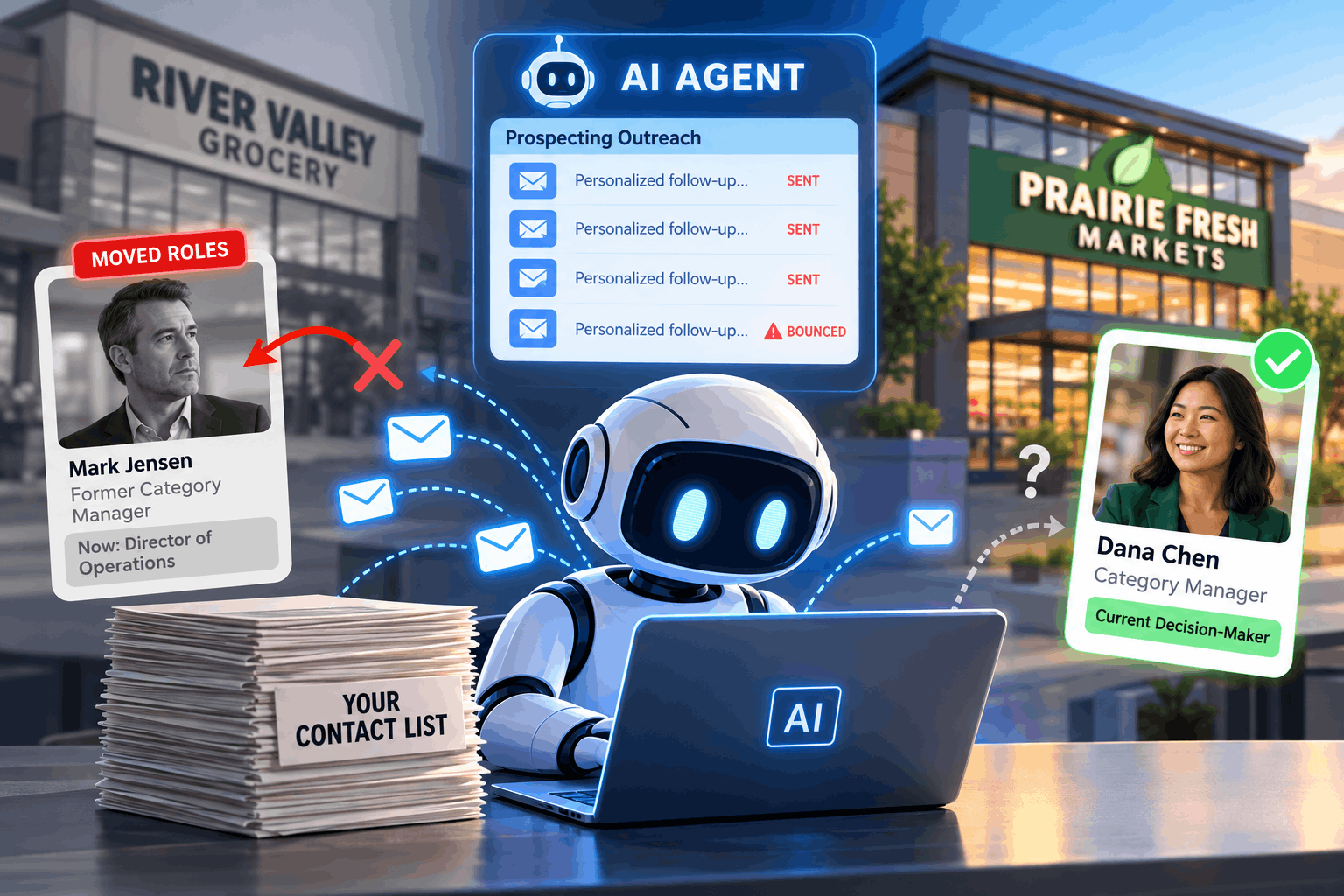
AI is moving into prospecting and purchasing. The data underneath it decides who wins. AI in B2B has movedhttps://www.chainstoreguide.com.

October 2, 2026
Near-record diesel and rising food costs are pulling chain sourcing closer to home. Every truck pulling up to a storehttps://www.chainstoreguide.com.