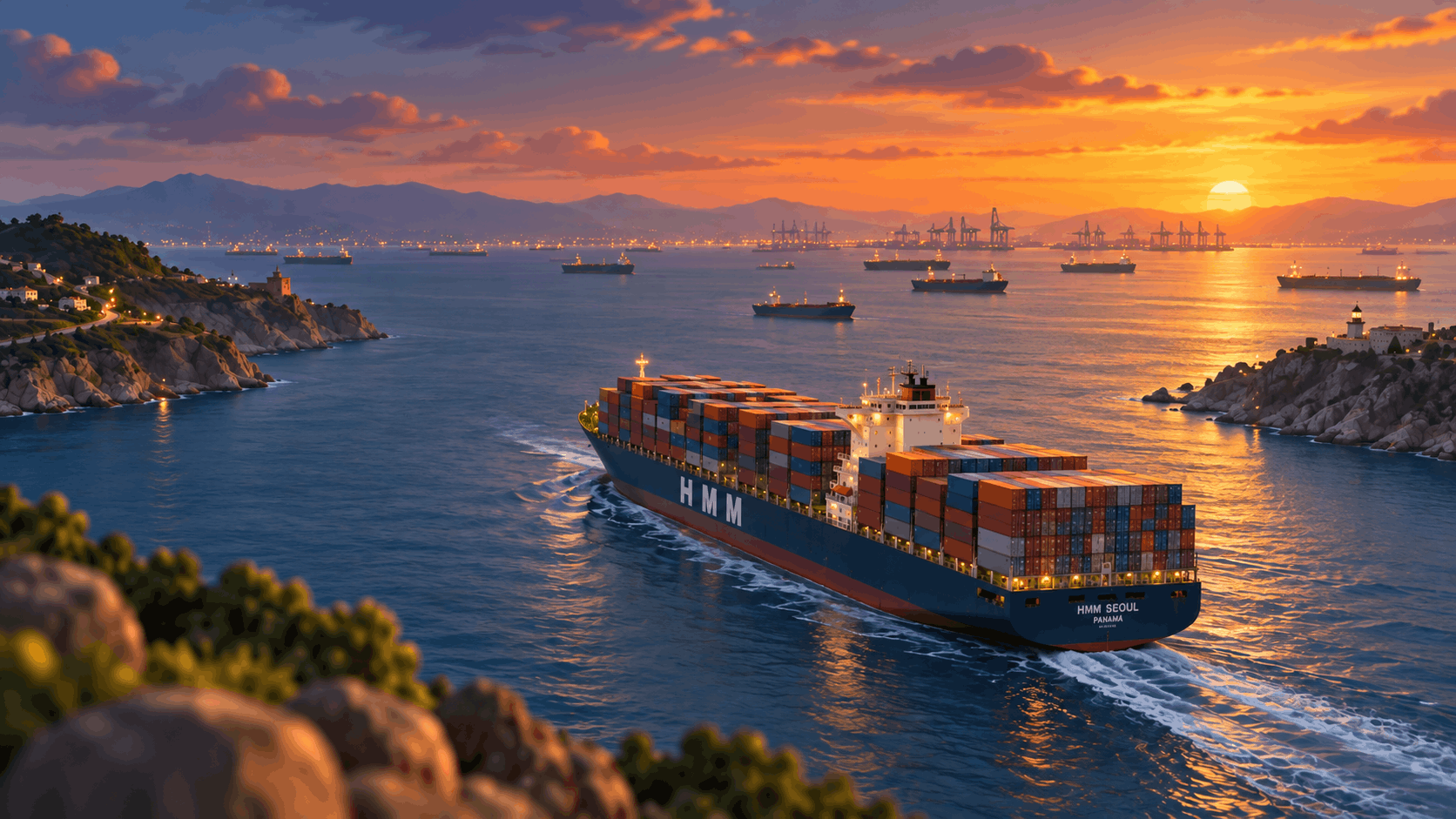

The Red Sea war isn’t over. Nobody decided that it just kind of dropped out of the headlines. Houthi forces staged a fresh advance last week, and shippers barely reacted. Cosco, OOCL, and CMA CGM kept pushing Suez Canal transits through anyway. Two and a half years in, carriers have basically stopped waiting for this conflict to end before they make a move.
Carriers have also learned not to trust their own bets. Back in December, CMA CGM sent its biggest ship, the 23,000-TEU Jacques Saade, through the Suez Canal for the first time in two years. Looked like the worst was finally behind everyone. Six weeks later, CMA CGM did a complete about-face, rerouting three major Asia-Europe services back around Africa, citing a “complex and uncertain international context.” Whatever time it had just saved was gone overnight. This corridor has bitten the industry before too, most famously in 2021 when the Ever Given wedged itself sideways and held up $9.6 billion a day in cargo for six days. That was an accident, cleared in under a week. This is a war, and it’s now run for two and a half years straight, with Suez Canal traffic still sitting about a third below normal.
And the Red Sea isn’t the only front anymore. In February, US and Israeli strikes on Iran shut down the Strait of Hormuz within 48 hours, a chokepoint that normally carries about a fifth of the world’s oil and a meaningful share of its container traffic. Asia-to-US container rates jumped 109% in the weeks after the strikes began, and war-risk insurance through the strait climbed to roughly four times its five-year average. Some carriers have absorbed the hit. Others have passed it straight through, and a few smaller freight operators have already buckled under the margin pressure.
That instability is stacking on top of a cost problem retailers were already dealing with, and this year’s holiday season is where it’s showing clearest. Deloitte’s 2026 Retail Industry Global Outlook found that 95% of retail executives expect trade policy to push costs up this year, and 66% are already planning to restructure their supply chains, including who they buy from. The National Retail Federation’s Global Port Tracker recorded an unusually early peak import season in 2026 as a result, and NRF’s own vice president for supply chain policy named the reason directly, pointing to tariff changes alongside “the ongoing disruption brought by the conflict in Iran.” Retailers that normally build holiday inventory through October front-loaded shipments months ahead of schedule instead, and the peak still ran longer than expected into September.
95% of retail executives expect rising costs from global trade policy in 2026, and 66% plan to restructure their supply chains, including diversifying their supplier base, in response.
Source: Deloitte, 2026 Retail Industry Global Outlook
For suppliers selling into retail chains, that’s not background noise. Rerouting around Africa still tacks on 10 to 14 days and real money, often $800 to $1,500 extra per container on China to US East Coast lanes, with war-risk insurance harder to secure at any price on top of that. All of it is pulling retail buyers’ attention away from the vendor relationships they used to manage on autopilot, and toward safety stock, routing buffers, and coverage headaches instead, right in the middle of holiday prep.
That shift in attention is exactly why this is the moment to show up. When two-thirds of retail buyers are actively rethinking their supplier base, the relationship you thought was locked in probably isn’t. Nobody this deep in a routing and insurance headache is going to wait around for a trade show to find someone new.
That’s where CSG LeadSearch™ earns its keep. Daily data refreshes, unlimited exports, all built to move as fast as the decision-makers themselves are moving. The next reroute is approaching. What’s actually in question is whether you’ll already know who to call when it happens.
See how CSG LeadSearch™ can put you in front of the right contacts today at chainstoreguide.com.
Sources: Lloyd’s List Intelligence, Red Sea Brief, September 3, 2026; WWD/Sourcing Journal, September 2026; Global Trade Magazine, January 2026; Deloitte 2026 Retail Industry Global Outlook, January 8, 2026; National Retail Federation, Global Port Tracker, September 9, 2026.




October 8, 2026
AI is moving into prospecting and purchasing. The data underneath it decides who wins. AI in B2B has movedhttps://www.chainstoreguide.com.

October 2, 2026
Near-record diesel and rising food costs are pulling chain sourcing closer to home. Every truck pulling up to a storehttps://www.chainstoreguide.com.

September 24, 2026
Kraft Heinz and Sam’s Club show grocery buyers are now judging prices and ingredients as one decision, not two. https://www.chainstoreguide.com.