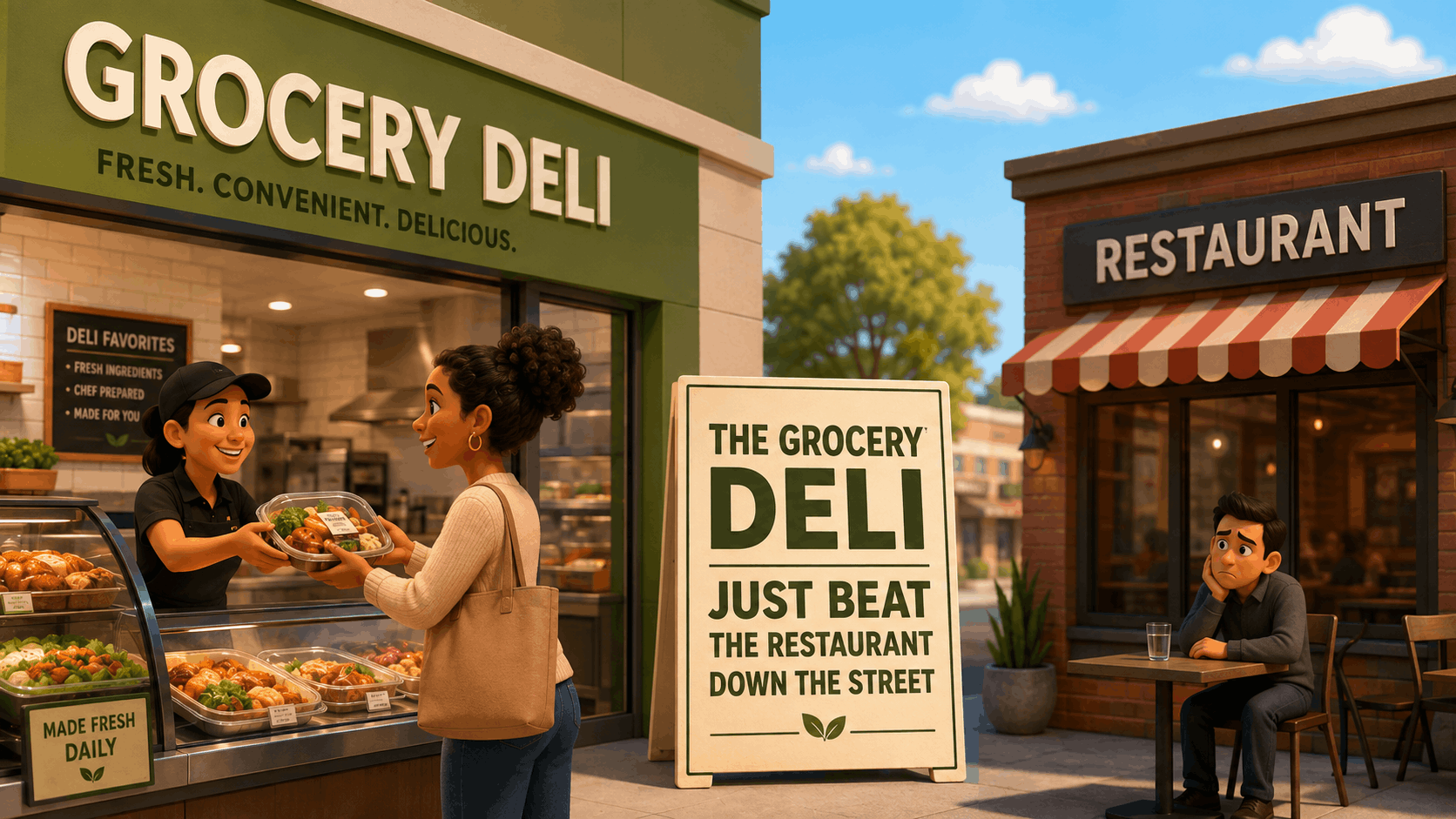

Twelve percent. That’s how many grocery shoppers said, back in 2017, that they bought a deli-prepared meal instead of going out to eat. Today that number is 28 percent, more than double, according to FMI’s Power of Foodservice at Retail 2025 report. Retail foodservice sales climbed to $52.1 billion over the past year, and 23 percent of shoppers say they’re stopping less often at fast food and fast casual restaurants because of it.
This is not a pandemic hangover. It’s a structural shift in where people expect a finished meal to come from, and the chains are backing it with capital, not just marketing copy. Kroger just opened a 6,500 square foot “deli of the future” in Edgewood, Kentucky, roughly four times the size of a standard Kroger deli, built around an open kitchen, a Murray’s Cheese counter, and a sushi bar. It cost $25 million, and Kroger has said the concept is a prototype for more stores if it performs well. Publix is leaning the same direction from a different angle, expanding its Aprons prepared foods line with new brisket sandwiches and oven-ready dinner kits built for the meat case rather than the deli counter. Further north, Wegmans and H-E-B are pushing into new markets partly on the strength of their prepared food reputations, enough that trade press now frames them as a bigger threat to Kroger than any e-commerce upstart.
28%
of grocery shoppers now buy deli-prepared meals as a replacement for eating at a restaurant, more than double the 12% who said the same in 2017. Retail foodservice sales reached $52.1 billion over the past year.
Source: FMI, Power of Foodservice at Retail 2025
That momentum is landing at an awkward moment for beef specifically. Tyson Foods announced this month it is closing beef plants in Joslin, Illinois and Eagle Mountain, Utah, citing a national cattle herd at its lowest level since 1951. Retail beef prices hit a record $9.64 a pound in April, up roughly 13 percent year over year. For retailers building protein-forward programs around brisket subs and steakhouse sandwiches, that’s a sourcing problem as much as a merchandising win, and it puts a premium on suppliers who can guarantee capacity rather than just compete on price.
Shoppers aren’t only buying more; they’re buying differently. More than half now build hybrid meals, pairing a prepared entree with something cooked from scratch at home, rather than treating deli food as an either-or substitute for cooking. Fully cooked meat sales grew 4.8 percent over the past year, pizza 4.5 percent, sushi 3.8 percent.
The delivery side of prepared meals tells a related but distinct story. Pure subscription meal kits, the HelloFresh and Blue Apron model that defined the category a decade ago, have cooled considerably amid slowing growth and stubbornly high churn. What’s holding up instead is anything anchored to a retailer or built for true heat-and-eat convenience. Kroger’s Home Chef sells meal kits both by subscription and directly off grocery shelves, and HelloFresh itself has leaned harder into Factor, its ready-to-eat subsidiary, rather than the original cook-from-scratch box. The broader prepared meal delivery market is still projected to grow at a healthy rate through the early 2030s, but the winners increasingly look like retail extensions rather than standalone delivery brands.
The buying moment has moved online too. Sixty six percent of shoppers say an online menu would influence their purchase, and 62 percent want to order ahead through an app. FMI’s 2026 Food Retailing Industry Speaks report found 77 percent of food retailers plan to expand the physical space they give to foodservice this year.
For B2B suppliers selling into chain retail, all of this is a signal to move now, not after the next RFP cycle. Every one of those store-level bets, in the deli, the meat case, or the meal kit shelf, translates into a live purchasing decision somewhere inside the account: an ingredient or protein supplier being evaluated for the next open-kitchen concept, a packaging vendor bidding on a meat-case meal kit line, a foodservice tech provider pitching the digital ordering build-out grocers are racing to fund. The chains committing capital fastest to prepared foods are the same chains actively sourcing new partners right now, and the beef squeeze only sharpens the case for suppliers who can offer sourcing stability alongside product quality.
The catch is that these buying decisions rarely sit with a single, obvious title, and the org chart looks different at every banner. Suppliers who wait to find the right contact through a cold LinkedIn search or a general sales inbox are already behind the ones who built the account list first.
That’s the gap CSG’s Grocery Retail Elite closes, with more than 77,000 verified contacts across supermarkets, drug chains, dollar stores, and convenience retailers, so a sales team can target the fresh foods and deli category leads driving these programs instead of guessing at a title. Location IQ’s geo-coded data across more than 708,000 retail and foodservice locations adds the where to the who, showing exactly which banners and regions are expanding, so outreach follows the capital rather than chasing it after the fact.
The restaurant industry spent a decade treating the grocery deli as a minor annoyance. That’s no longer a safe assumption for anyone selling into either channel. The suppliers who treat this as a market shift, and build their account strategy around it now, will be the ones already in the room when the next mega-deli goes out to bid.
The deli didn’t just come back. It came back with a supplier list, and the question is whether you’re on it.



October 15, 2026
Chick-fil-A won’t shrink the sandwich. Costco won’t touch the hot dog. The cost has to land somewhere, and suppliers arehttps://www.chainstoreguide.com.

October 8, 2026
AI is moving into prospecting and purchasing. The data underneath it decides who wins. AI in B2B has movedhttps://www.chainstoreguide.com.

October 2, 2026
Near-record diesel and rising food costs are pulling chain sourcing closer to home. Every truck pulling up to a storehttps://www.chainstoreguide.com.